USAXS/SAXS/WAXS Facility
Ultra-Small-Angle, Small-Angle, and Wide-Angle (Diffraction) X-ray Scattering
The USAXS/SAXS/WAXS facility at the Advanced Photon Source combines three instruments — a Bonse-Hart USAXS/SAXS scanning device, a 500 mm pinhole SAXS camera, and a 300 mm 2D-detector powder diffraction (WAXS) device — into a single station. In one measurement sequence of about 2 minutes, it characterizes structures from 6 micrometers down to below 1 Angstrom, serving users in physics, chemistry, materials science, polymers, food science, biology, and many other fields.
World-unique capabilities:
- More than 5 decades in size range — 6 µm to <1 Å in standard resolution (higher sensitivity); 20 µm to <1 Å in high resolution (lower sensitivity)
- Intensity range of up to 12 decades
- ~2 minutes combined data collection time
The instrument is located in the 12-ID-E station and operated by the CMS group.
Instrument scientist: Jan Ilavsky, 630-252-0866
Current instrument paper: Ilavsky, J., Zhang, F., et al. (2018). "Development of combined microstructure and structure characterization facility for in situ and operando studies at the Advanced Photon Source." Journal of Applied Crystallography 51, 867–882. https://doi.org/10.1107/S160057671800643X
Is this instrument right for your samples?
Use of the Bonse-Hart USAXS/SAXS device is required for access to this instrument; users who need only conventional SAXS/WAXS should apply to other APS SAXS/WAXS instruments dedicated to those techniques, e.g. 12-ID-E SAXS/WAXS, 12-ID-B SAXS/WAXS or many others.
The instrument's sensitivity is limited by the Bonse-Hart crystal surface background, so it cannot measure very weak signals — such as those common in bioSAXS (proteins) or very dilute systems. We offer a modeling tool (link to YouTube) that calculates the expected signal from your sample. If in doubt, talk to staff.
If you are considering applying for beamtime, these pages explain the instrument's specifics:
- What is the USAXS instrument
- Data collection strategy
- Data import to Igor
- Igor data description
- Sample plates setup
How to get access
- General User (GU) program — about 80% of beamtime. See All about proposals.
- Mail-in program — about 2–3 days of beamtime per cycle for users with smaller sample sets (typically fewer than 20 samples). Typical use is exploratory research (before applying for beamtime) or projects requiring only a limited number of samples. No beamtime proposal is necessary and users do not come to the APS. Samples are handled by staff and reduced data are sent back to users. See the dedicated mail-in page.
- Proprietary (industrial) research — available as part of the GU program. Contact staff and the APS Users Office; start here.
- SAXS-SANS collaboration mail-in program — see the program page or contact staff.
Important APS user information page.
Technical details
Data are collected sequentially using one, two, or three of the available instruments, in any order. Changeover time between any two devices is about 5 seconds.
Beam sizes:
- USAXS: typically 1 × 1 mm, adjustable down to 0.2 × 0.2 mm. Smaller beams reduce flux and therefore require more strongly scattering samples or longer collection times.
- SAXS/WAXS: typically 0.8 × 0.2 mm, also reducible to 0.2 × 0.2 mm, with the same trade-off.
Collection times:
- Combined USAXS/SAXS/WAXS: typically less than 2 minutes
- Standard USAXS scan: 30–120 s (typically ~90 s); high-resolution scan: 3–6 minutes
- SAXS and WAXS exposures: 1–5 s each (commonly ~2 s SAXS, ~5 s WAXS)
Scheduling: The instrument shares the 12-ID-E hutch with the 10 m SAXS instrument and is therefore scheduled for approximately 50% of APS allocated beamtime, about 2000 hours per year.
Standard USAXS configuration (Si 220 crystals, slit smeared) — default
- Energy range: 10–28 keV (typical 21 keV)
- Q range, combined: 8×10⁻⁵ to 6 Å⁻¹
- Q resolution, USAXS: 8×10⁻⁵ Å⁻¹ in the USAXS range (up to ~0.1 Å⁻¹)
- Size range, combined: 6 µm – 1 Å
- Collection time, combined: <2 minutes
- Intensity range: up to 12 decades (depends on sample), desmeared
- SAXS Q range: ~0.03 to 1.3 Å⁻¹
- WAXS Q range: ~0.8 to 6 Å⁻¹
High-resolution USAXS configuration (Si 440 crystals, slit smeared) — on request
NOTE: this is a low-sensitivity setup and needs strongly scattering samples.
- Energy: 20, 21, 24, and 28 keV
- Q range, combined: 3×10⁻⁵ to 6 Å⁻¹
- Q resolution, USAXS: 3×10⁻⁵ Å⁻¹ in the USAXS range (up to ~0.1 Å⁻¹)
- Size range, combined: 20 µm – 1 Å
- Collection time, combined: 3-6 minutes (step scanning only)
- Intensity range: up to 12 decades (depends on sample), desmeared
- SAXS Q range: ~0.03 to 1.3 Å⁻¹
- WAXS Q range: ~0.8 to 6 Å⁻¹
USAXS Imaging
Not available until after the APS upgrade and beamline improvements (~2027?).
Data
The USAXS instrument data reduction pipeline Matilda generates data that are fully normalized and calibrated. In practice, this means the data are corrected for sample transmission and, when a meaningful sample thickness is available at the time of measurement, placed on an absolute intensity scale with units of [cm²/cm³] = [1/cm]. Absolute calibration also requires background subtraction.
Although the instrument uses slit collimation (and therefore produces slit-smeared data), our standard reduction workflow includes desmearing using the Lake method. As a result, the data delivered to users are typically desmeared, equivalent to standard pinhole-collimation data, and suitable for direct modeling with most common analysis tools.
The standard reduced data set includes:
- Scattering vector, q [1/Å]
- Intensity (absolutely calibrated when applicable*)
- Intensity uncertainty ("error")
- dQ (q-resolution for each point, units [1/Å]; values vary by point)
Original slit-smeared data are also available in the HDF5 files or can be provided on request in other formats. In those cases, the slit length is included as well (units [1/Å], constant for all points).
Data are available in several formats:
- Combined raw and calibrated HDF5 files (see the movie below and consult the manual for details)
- Igor Pro experiment files
- ASCII text formats on request (such as
.txt,.dat, and similar)
For users of Irena, pyIrena, SasView, or other applications that can read HDF5 files and support the NXcanSAS format, the HDF5 files alone are often sufficient and no additional data export may be needed.
Resources: YouTube movie, Indra manual, Nexus format, NXsas definition, NXcanSAS definition
*Absolute calibration is performed under the assumption that the sample thickness is both meaningful (for example, not loose powders) and known before measurement. In most cases, thickness is measured and provided by the user prior to data collection. If no thickness value is supplied, the system uses a default sample thickness of 1 mm. More advanced or specialized absolute calibration procedures can also be performed when arranged with instrument staff in advance and properly configured for the experiment.*
Instrument schematics and data ranges

Schematics of the USAXS–SAXS–WAXS instrument (top view) with its three devices. Data are collected sequentially using any sequence of devices — one, two, or three as needed. Changeover time between any two devices is about 5 seconds. USAXS is a scanning technique that rotates the analyzer crystal for each measured position (typical scan time 90 s); SAXS/WAXS use area detectors with 1–5 second exposure times.

Data ranges collected with the different devices. The USAXS range is about 3.5 decades (0.0001–0.3 Å⁻¹) in normal mode and 4 decades (0.00003–0.3 Å⁻¹) in high-resolution (low-sensitivity) mode. The SAXS range is about 0.04–1.1 Å⁻¹ and the WAXS range about 1–6 Å⁻¹. SAXS and WAXS ranges also depend on X-ray energy, while the USAXS range is about the same for all X-ray energies and configurations we offer users.
Examples of USAXS results
Review papers: Review of USAXS in hard materials, Review of USAXS in protein systems
Science highlights:
- 2018: Additive manufacturing USAXS science highlight
- 2019: USAXS in chocolate science (APS version, Confectionerynews version)
- 2020: APS scientific highlight — Pickering emulsions
- 2021: APS scientific highlight — Colloidal gels
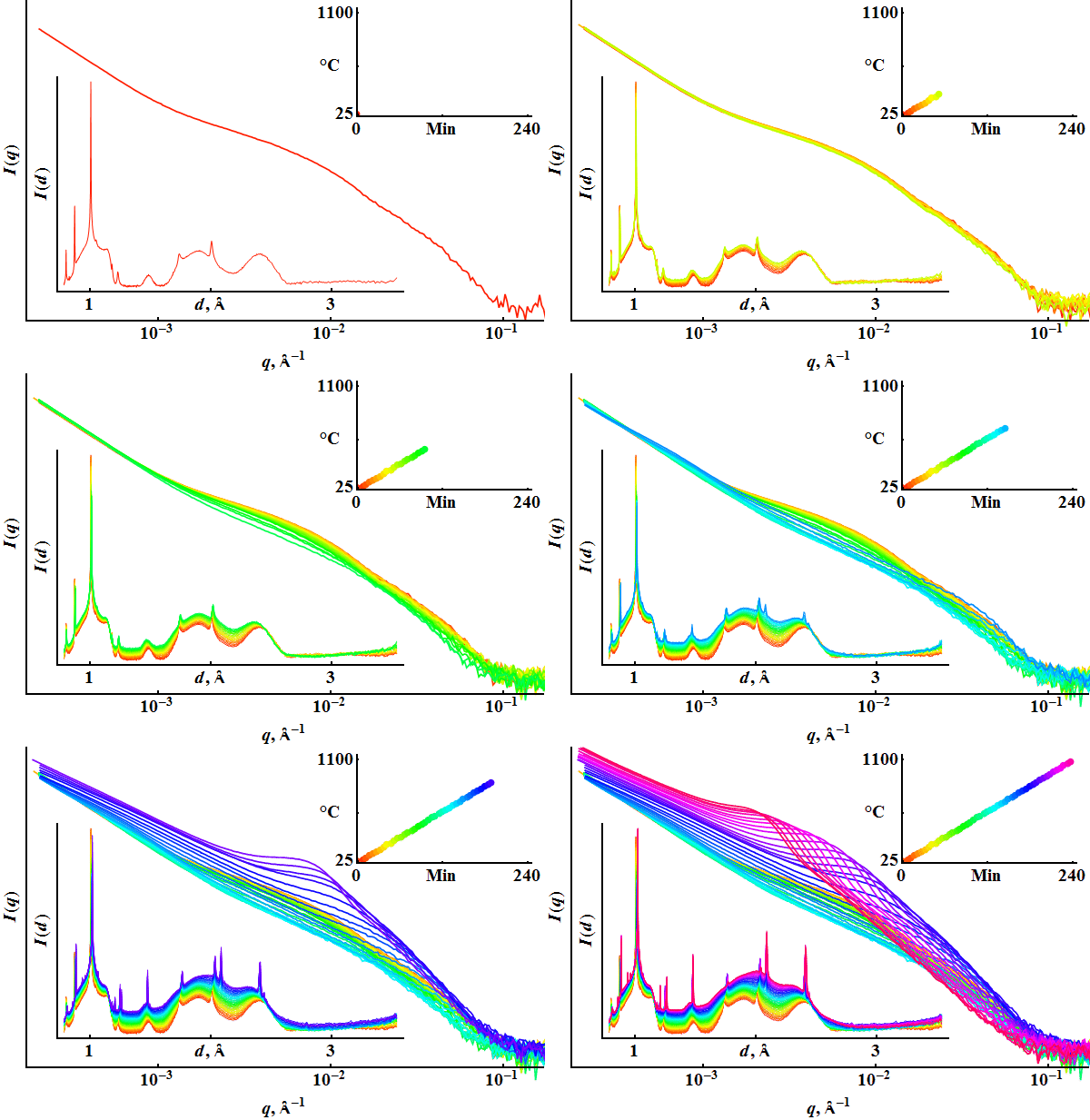
An in-situ USAXS-SAXS-WAXS study of precipitate dissolution and size evolution in a model gamma–gamma prime ternary Ni-based alloy (collaboration with Dr. G. Muralidharan, ORNL). A 0.1 mm thick sample was heated from RT to 1100 °C at 4.5 °C/min while undergoing repeated USAXS-SAXS-WAXS (24 keV) at 5-minute intervals. Research sponsored by the U.S. Department of Energy, Assistant Secretary for Energy Efficiency and Renewable Energy, Office of Vehicle Technologies, as part of the Propulsion Materials Program.
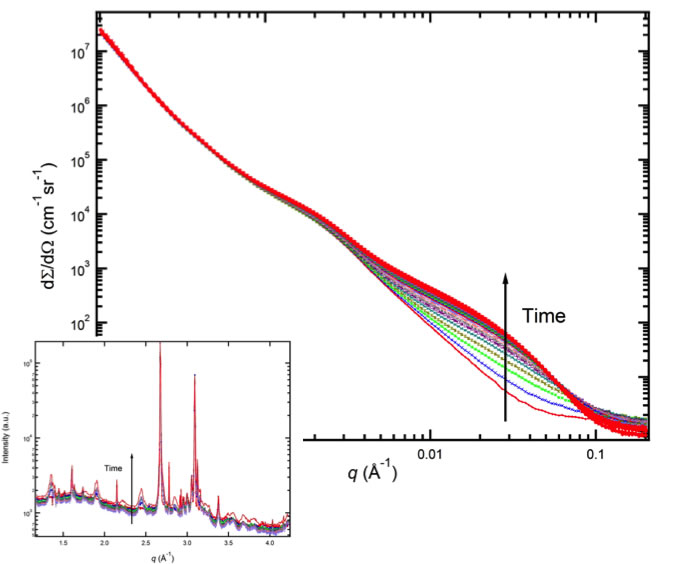
USAXS/SAXS/WAXS data: In situ data collected at 226 °C over about 16 hours show the microstructure evolution of AA2024 aluminum alloy (Allen, Levine, and Zhang, NIST). USAXS data enable quantification of second-phase formation (size and volume); WAXS enables phase identification.
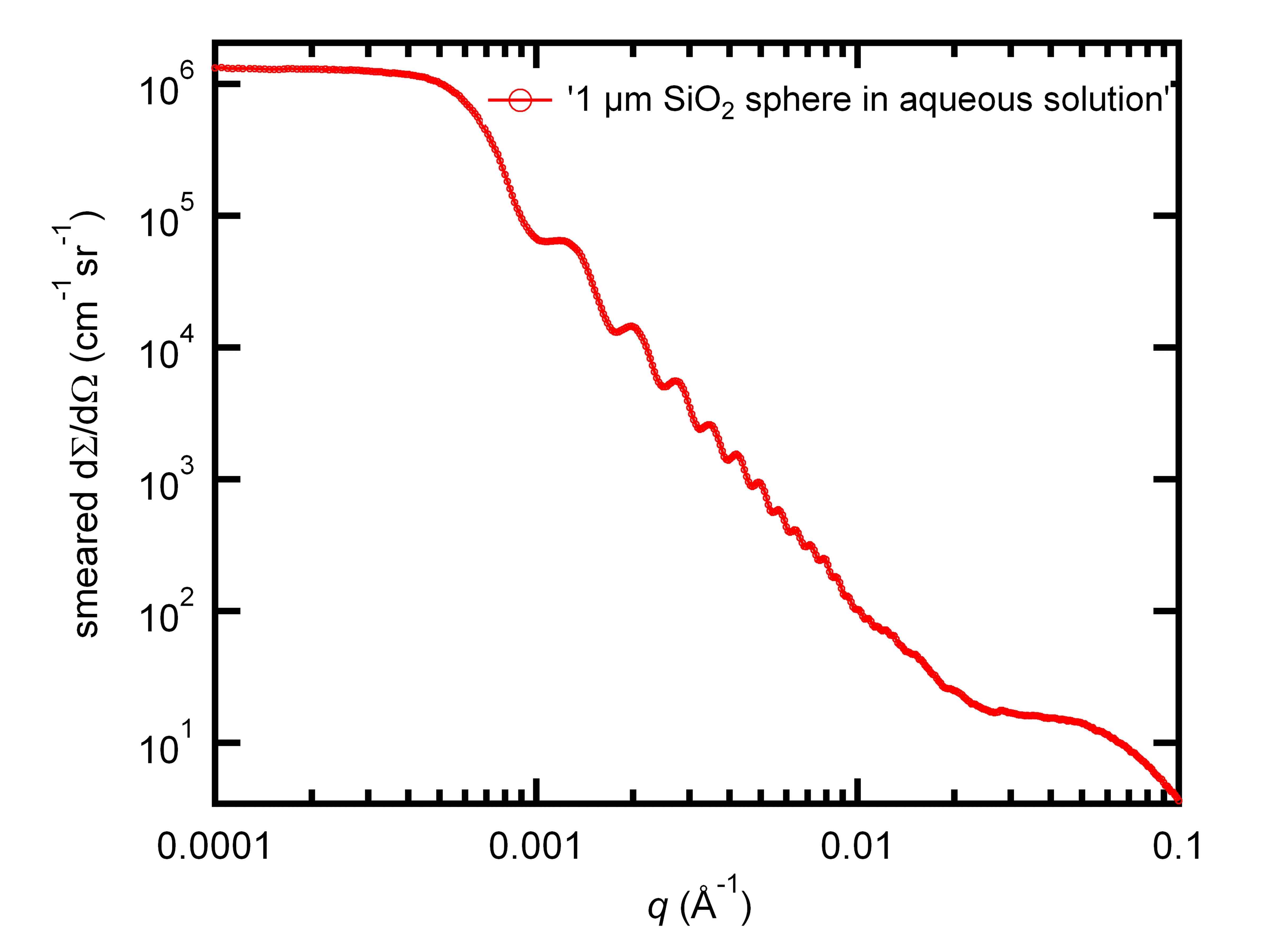
Scattering of 1 micron SiO2 spheres in aqueous solution.
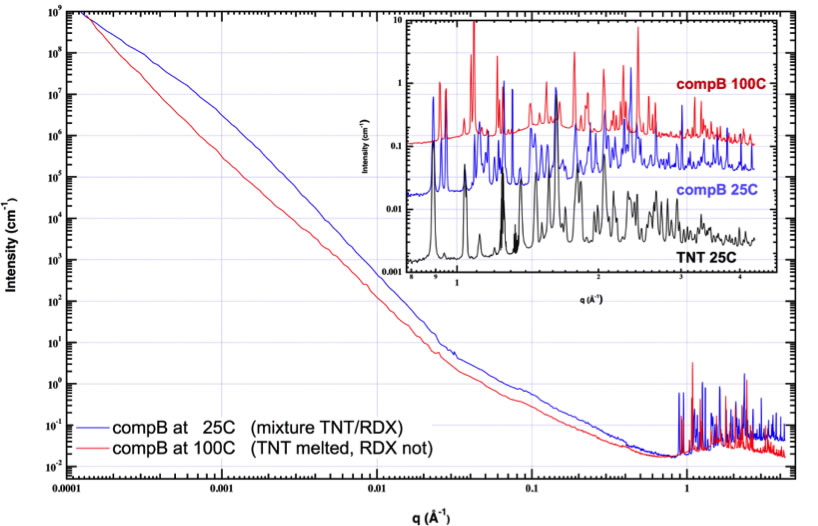
USAXS/SAXS/WAXS in situ data collected by LLNL (Trevor Willey et al.) on high explosives. The material is a composite of two high explosives and a plastic binder. WAXS clearly shows phase changes while USAXS/SAXS data show microstructure change as a function of heating.
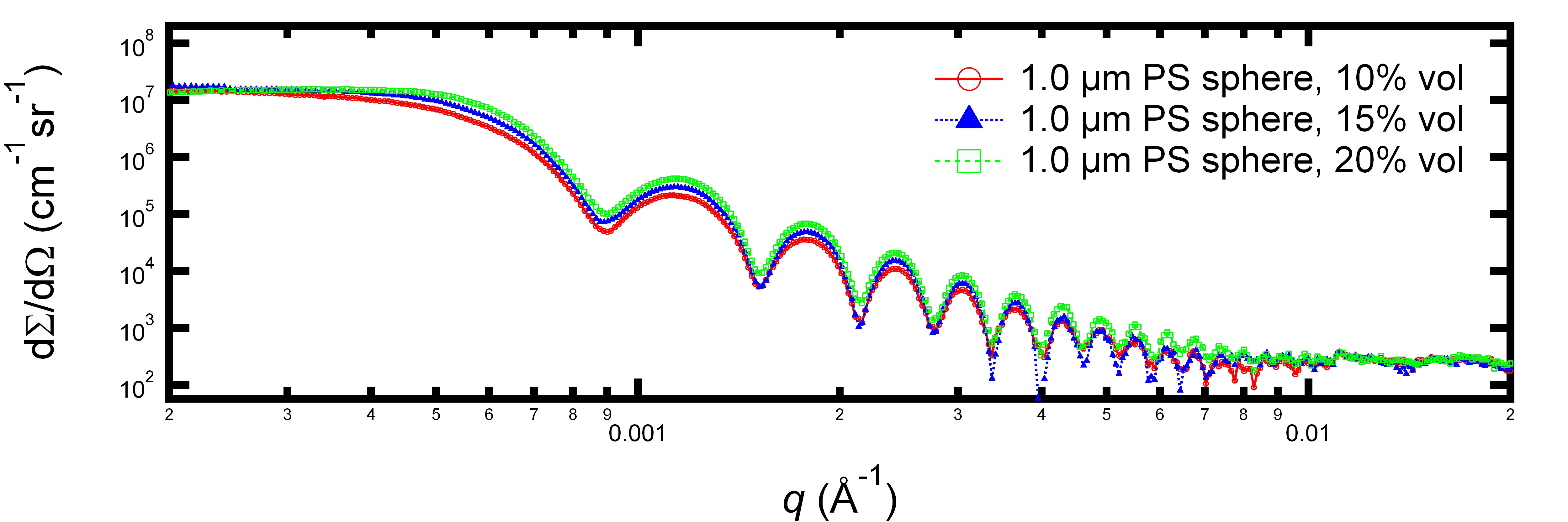
Scattering of 1 micron polystyrene spheres in solution.